Web Summit 2026: Why the Future of Business Will Be Shaped in the Age of Agentic AI
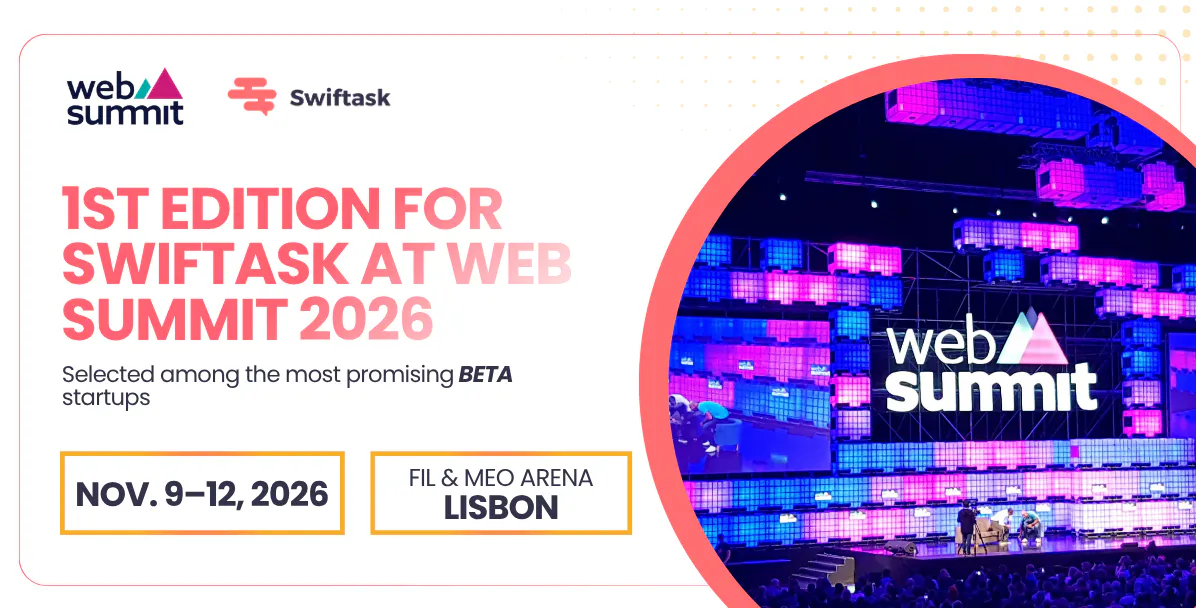
Every November, the gathering of more than 70,000 people from the tech industry at Parque das Nações in Lisbon raises the same questions: beyond the colossal logistics and the hype, what truly remains of these four days of excitement?
If Web Summit remains an unmissable event, it is above all because of its ability to reveal the industry’s early signals. What takes shape in the corridors of FIL or on the stages of the MEO Arena often foreshadows the strategic decisions that will surface in executive boardrooms six months later.
This year, for the first time, the Swiftask team will be travelling to Lisbon. The goal is not merely to make an appearance, but to decipher a major technological shift that directly affects business productivity and organisational structures.
Behind the Scenes of a Giant Barometer of Global Tech
Founded in Dublin in 2009 with just 150 attendees at its first edition, before moving to Portugal in 2016, Web Summit has established itself as Europe’s leading major technology gathering.
For the 2026 edition, the scale remains impressive:
More than 70,000
professionals from 160 countries.
2,300 startups
coming to showcase their solutions.
900 speakers
across around twenty specialised stages.
1,200 investors
seeking tomorrow’s business models.
However, the event’s fundamental value does not lie in its sheer scale. Unlike a conventional trade show, Web Summit operates as a powerful industry barometer. For four days, founders, decision-makers, regulators, and engineers compare their visions in real time, helping to recalibrate market priorities.
The Major Shift from Generative Models to Autonomous Agents
For nearly three years, the debate surrounding artificial intelligence has focused on the raw performance of large language models (LLMs): writing capabilities, image-generation speed, and the size of context windows. Today, this emerging phase is giving way to a more profound transformation: the transition to agentic AI.
The objective is no longer simply to have an interface capable of querying a knowledge base or drafting a concise text. The focus is now on deploying autonomous systems that can execute operations, interact with software APIs, and manage end-to-end business workflows. This marks a shift from a conversational assistance tool to a true execution-oriented virtual teammate.
This transition also brings significant operational challenges. On the AI Summit stage, the issue will be addressed head-on: while autonomous agents represent the new operational frontier, many companies still struggle to define a framework for integrating them:
Barriers to adoption and uncertainty around return on investment.
Security, governance, and data privacy challenges.
Technical complexity of deploying these architectures in production without breaking the operational chain.
The central question at this gathering will therefore not be what AI is capable of writing, but rather how to create the conditions needed to integrate fleets of agents into the core of an organisation’s critical processes.
Key Strategic Themes to Watch in the Programme Among the hundreds of scheduled sessions, four major themes will particularly capture our attention:
Open Models vs. Black Boxes
The tension between proprietary systems accessed through APIs and sovereign open-source models will be a central theme of the AI Summit. This debate extends far beyond purely technical considerations: it determines the degree of control an organisation truly has over the infrastructure that underpins its strategic data.
Sovereignty Through the Execution Layer
During the session dedicated to technological sovereignty—featuring, in particular, Samar Abbas, co-founder of Temporal—the focus will be on execution infrastructure. For European companies, ensuring the integrity of their processes requires full control over where operations are hosted and processed.
The European Regulatory Framework
The presence of Henna Virkkunen, Executive Vice-President of the European Commission, will make it possible to address regulatory compliance not as a legal obstacle, but as a foundational constraint from the earliest stages of AI architecture design.
Lessons Learned from Industry Builders
Talks by figures such as Tao Zhang (Manus AI), Michele Catasta (Replit), and Mike Cannon-Brookes (Atlassian) will offer an overview of current practices. Comparing their real-world experiences will help identify the use cases that are genuinely viable in practice.
Web Summit: “The Place to Be”
As a provider of a platform that enables businesses to deploy AI agents within their operational workflows, we felt it was essential to be in Lisbon for Web Summit 2026.
Share this event
Link copied to clipboardSimilar events
→
IA'm READY 2026
"Salon de la Data et de l’IA": Swiftask at the heart of the business AI debate
Forum Atlanpole recap: Spotlighting innovation in Western France
Are you organizing an AI event ?
Partnerships, co-webinars, client presentations — join the Swiftask ecosystem and reach your decision-makers.