Table of contents :
Model-Agnostic AI: Core Principles, Key Criteria, and Limitations
A model-agnostic AI platform is designed to avoid relying exclusively on a single AI model or provider. But the term alone does not guarantee that you can switch models without adjustments, keep every workflow unchanged, or get the same results. Here’s how to distinguish basic multi-model access from flexibility that is genuinely useful to a business.
Ready to transform your business with AI?
Discover how AI can transform your business and improve your productivity.
What is model-agnostic AI?
In a business context, model-agnostic AI describes a tool or architecture that can work with multiple AI models rather than being tightly tied to just one.
Model agnosticism is about how a solution interacts with AI models. It can make choosing or replacing a model easier, but the level of flexibility varies from one platform to another. The term itself is not a technical guarantee. To understand what it means in practice, examine what you can actually change—and how much work that change requires.
Three related concepts are often confused:
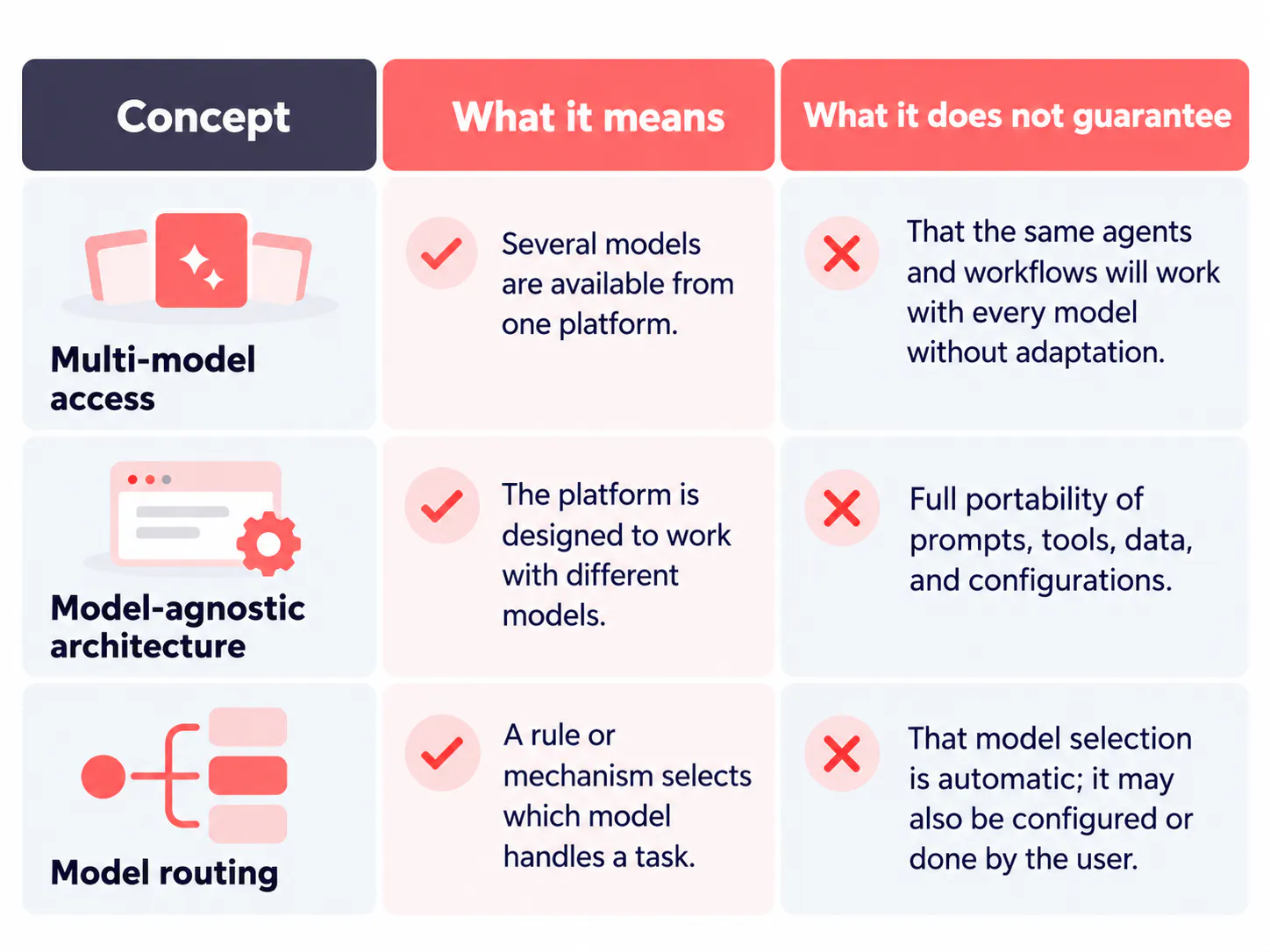
A platform can offer several models without automatically routing requests between them. And switching models may require adjustments, even when multi-model access is available.
Why does this flexibility matter to businesses?
Models change, and requirements vary by use case. One team may need a model suited to a specific task, while another may have different quality, cost, privacy, or availability requirements.
Access to multiple models can help a business:
- Compare different options for a given task.
- Choose a model based on its needs, rather than using the same model for every purpose.
- Keep an alternative available if a model changes or no longer meets expectations.
- Centralize access to models in a shared environment.
These benefits are not automatic. Having several models available does not necessarily mean better results, lower costs, or frictionless migration. A platform should be evaluated against the organization’s actual use cases.
Multi-LLM does not always mean “vendor-independent”
Vendor lock-in describes dependence on a provider that can make switching to another solution costly or difficult. Access to multiple LLMs may reduce some of that dependence, but it does not necessarily eliminate it.
A business may still depend on:
- A platform, if its agents and automations rely on proprietary features.
- A model, if its instructions, tools, or output formats are specific to it.
- A data-management approach, if data transfer or processing limits the choice of another provider.
- A governance process, if access controls and usage rules are difficult to reproduce elsewhere.
In other words, switching the model is not the same as moving an entire architecture. Look beyond the list of models in the interface and check which other components are involved.
How to evaluate a model-agnostic AI platform?
To determine whether a solution offers useful flexibility, ask specific questions during the evaluation.
Which models can you access?
Check which models are actually available to your account, teams, and use cases.
Where can you choose or change the model?
Is the option available in the chat, in an agent’s configuration, or at another stage?
What needs to be adjusted after a switch?
Test the instructions, response formats, tools, and workflow steps.
Do the results still meet your requirements?
Compare models on representative tasks using the same quality criteria.
What are the data-related terms?
Review the providers involved, how data is handled, and the rules that apply to your organization.
How is model use governed?
Check who can select models and what monitoring or administration options are available.
A useful evaluation does more than count the models on offer. It looks at how easy they are to select, what needs to be adapted, the quality of the results, and how much control the organization retains.
Example: comparing models on a business task
Suppose a company wants to classify incoming customer-service requests. It could test several models on representative requests and compare their errors, response quality, processing time, and cost.
If another model appears to be a better fit, the team should also check whether the agent and its workflow still behave as expected. The instructions or output formats may need to be adapted. That validation is what reveals the platform’s real flexibility, beyond the simple ability to select a different model.
How does this work in Swiftask?
Swiftask provides access to multiple models through a platform that brings together chat and AI agent creation. Users can select a model in the chat or in an agent’s configuration, depending on the options available in the product.
This illustrates the practical value of multi-model access: choosing an AI model in one environment and using it in a conversation or an agent. That flexibility should not be confused with a promise of identical results or complete interoperability across all models.
- To explore the platform, visit the Swiftask AI Hub.
- For instructions on changing models in Swiftask, see the guide Switching an AI agent to other models.
FAQ about model-agnostic AI
Not exactly. Multi-LLM means a solution provides access to several large language models. Model-agnostic AI describes an approach that aims to avoid relying exclusively on one model. A multi-LLM solution can offer several choices without guaranteeing a fully portable architecture.
Not necessarily. It may reduce dependence on an AI model provider, but workflows, integrations, data, or specific features may still be tied to the platform. Each of these should be assessed separately.
No. Different models may interpret instructions differently, return different formats, or vary in quality. Test important use cases after changing models.
No. How a model is distributed and how a platform is architected are separate issues. Model agnosticism depends on how the solution can integrate and manage different models.
Key takeaways
Model-agnostic AI describes an approach that seeks to avoid exclusive dependence on one model. To assess what that means in practice, check which models a platform lets you select or replace, what needs to be adapted, and what controls remain available.
Explore the Swiftask AI Hub to see how Swiftask brings multiple models and AI agents together in one environment.
author
OSNI

Published
September 18, 2026
Ready to transform your business with AI?
Discover how AI can transform your business and improve your productivity.